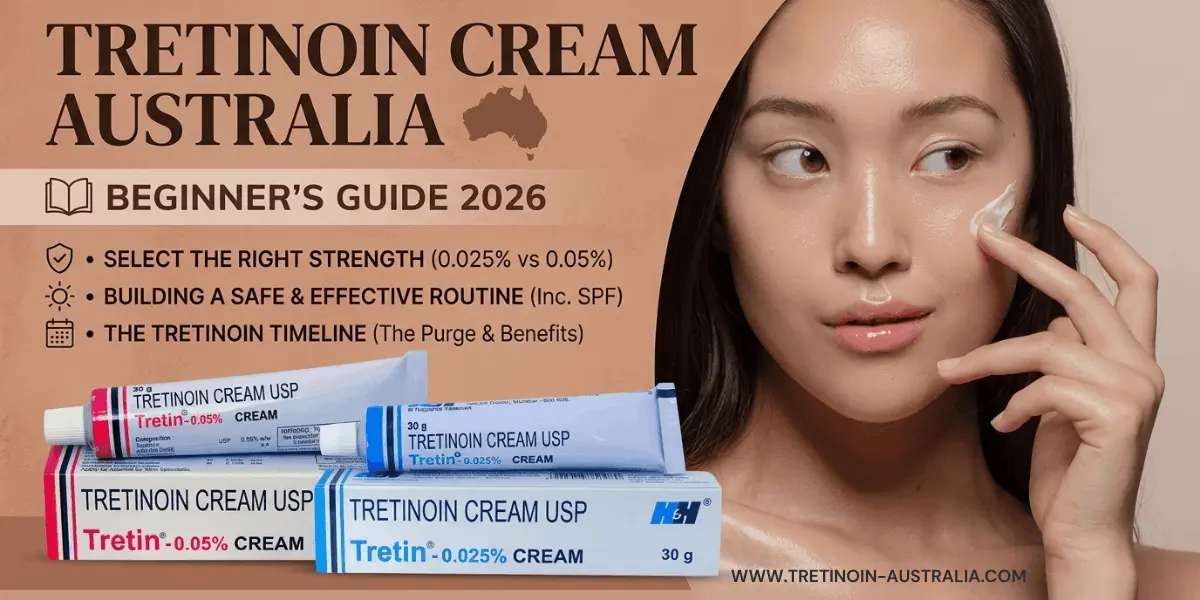
If you've been searching for tretinoin cream Australia, you've probably hit a wall of conflicting advice. Some sources treat it like a miracle cure. Others make it sound too harsh for anyone without a dermatology degree. The truth sits firmly in the middle — and it's worth understanding before you book a GP appointment.
Tretinoin is one of the most clinically supported topical treatments in dermatology. Clinical trials show it can reduce inflammatory acne lesions by 52% within 12 weeks (PubMed, 2018). But those results come from patients who introduced it slowly, kept their routines simple, and didn't expect change overnight.This guide explains what is tretinoin cream, how it works in the Australian context, who it suits, and how to start without wrecking your skin barrier in the process.
Key Takeaways :
Tretinoin reduces inflammatory acne lesions by 52% and non-inflammatory lesions by 46% within 12 weeks, according to a published randomised controlled trial .That's the evidence behind the hype — and it's why dermatologists still reach for it as a first-line prescription option for acne-prone skin.
Tretinoin is a topical retinoid derived from vitamin A. Unlike cosmetic skincare products that work at the surface, it acts at the cellular level. It accelerates skin cell turnover, stops pores from becoming blocked, and — with consistent long-term use — can improve visible signs of sun-damaged skin. It doesn't just treat what you can see. It targets the process happening underneath.
In Australia, tretinoin is regulated as a prescription medicine, not a cosmetic. That distinction matters. Your GP or dermatologist decides whether it's appropriate for your skin before you ever use it.
Citation capsule: At week 12, a randomised clinical trial of tretinoin 0.05% lotion found a 52% reduction in inflammatory lesion counts and a 46% reduction in non-inflammatory lesion counts compared to vehicle (PubMed, 2018). This evidence base positions tretinoin as one of the most clinically validated acne treatments available on prescription in Australia.
How tretinoin works on the skin
Tretinoin targets the earliest step in acne formation: blocked pores. It encourages dead skin cells to shed more evenly, stopping them from mixing with sebum and clogging pore openings. The process is systematic, not fast.
Here's what regular tretinoin use can do:
That last point matters a lot in Australia, where UV exposure is intense and decades of sun damage often combine with ongoing adult acne.
This is where beginners get confused. Here's the short version.
Tretinoin is a prescription retinoid medicine. It works directly as retinoic acid — no conversion needed — and has the longest clinical evidence record of any topical retinoid for both acne and photoageing.
Retinol is an over-the-counter cosmetic. It's in the same family, but the skin must convert it into retinoic acid before it becomes active. Slower, weaker, and less predictable — though still useful for mild concerns.
Adapalene is another prescription retinoid, often considered better tolerated by sensitive skin types. It works through a slightly different mechanism and is also prescription-only in Australia.
Which one is right for you? That's a question for your prescriber. Not a Reddit thread.
Almost half of Australians aren't using adequate sun protection, according to Cancer Council Australia's 2024 data — and years of unprotected UV exposure shows up on skin as rough texture, uneven tone, and early photoageing (Cancer Council Australia, 2024). Tretinoin is one of the few topical medicines with solid evidence for addressing both active acne and those longer-term UV effects at the same time. That dual function is why it's become a meaningful part of many Australian skincare conversations.
Citation capsule: A 2024 Cancer Council Australia report found nearly half of Australians do not use adequate sun protection, in a country that records approximately 19,000 melanoma diagnoses per year and more than one million non-melanoma skin cancer treatments in 2023 (Cancer Council Australia, 2024). For Australians using tretinoin — which increases UV sensitivity — daily SPF 50+ sunscreen is a clinical necessity, not a lifestyle preference.
For acne-prone skin, tretinoin targets clogged pores directly. It's especially effective for:
It's also one of the few acne treatments with evidence for long-term prevention, not just short-term clearing. Many acne products treat what you can see today. Tretinoin helps stop tomorrow's breakout from forming.
Tretinoin has one of the strongest evidence bases of any topical treatment for photoaged skin. A landmark 1993 study in the New England Journal of Medicine found tretinoin produced an 80% increase in collagen I formation compared to a 14% decrease with vehicle alone (NEJM, 1993). More recent systematic reviews confirm that 71.9% of subjects showed measurable improvement in melanosis (pigmentation irregularity) after 24 weeks of tretinoin 0.05% (PMC, 2022).
That's real clinical data. Not marketing copy.
Why Australians need extra sun protection with tretinoin
Australia records the highest skin cancer rate in the world. Around 19,000 Australians are diagnosed with melanoma each year, with over one million treatments for squamous and basal cell carcinomas in 2023 — more than 100 skin cancer treatments every hour (Cancer Council Australia, 2024). Summer UV levels regularly reach 12–17 on the UV index, well into the extreme range.
Tretinoin makes skin more sensitive to UV radiation. Using it without daily broad-spectrum sunscreen in Australian conditions doesn't just blunt the treatment's effectiveness — it actively increases your risk of UV damage on already-sensitised skin.
Sunscreen isn't optional. It's part of the treatment protocol.
Yes — tretinoin is available in Australia, but only with a valid prescription. Retrieve cream (tretinoin 0.05% w/w) is registered with the Therapeutic Goods Administration under ARTG number 15553 and is manufactured by iNova Pharmaceuticals (TGA). It's classified as a Schedule 4: Prescription Only Medicine. No pharmacy can dispense it without a valid script.
Citation capsule: Tretinoin cream is regulated as a Schedule 4 Prescription Only Medicine in Australia. The branded product Retrieve (tretinoin 0.05% w/w) is TGA-registered under ARTG #15553, sponsored by iNova Pharmaceuticals . This means Australians cannot legally access tretinoin through a pharmacy, online retailer, or compounding service without a valid prescription from an authorised prescriber.
Yes, unambiguously. Under the Therapeutic Goods Act, tretinoin is a prescription-only medicine in Australia.
You need to see a GP, dermatologist, or other authorised prescriber who decides whether it's appropriate for your skin and situation. A pharmacy then dispenses it with a valid script.
Is this frustrating? Sometimes. Is it sensible? Yes. The wrong person using tretinoin — someone with active eczema, rosacea, or a significantly compromised skin barrier — can end up worse off than before they started. The prescription gatekeeping exists for good clinical reasons.
The best-known Australian tretinoin product is Retrieve cream, containing tretinoin 0.05% w/w. It's listed on Healthdirect as an available topical tretinoin medicine, and it's the product most GPs and dermatologists prescribe for acne and sun-damaged skin.
Combination products also exist — tretinoin paired with clindamycin, for example — used in specific clinical scenarios. These should always be prescribed and monitored by a clinician.
The standard pathway:
1. See a GP, dermatologist, or telehealth dermatology service
2. Discuss your skin concern — acne, texture, sun damage, or a combination
3. Receive a prescription if the clinician determines it's appropriate
4. Fill the prescription at a pharmacy (call ahead — some need to order it in)
Telehealth dermatology has made access more straightforward in recent years, though the prescription requirement remains regardless of how you see a doctor.
Around 1 in 5 adults aged 25–39 globally live with acne, according to a 2024 worldwide epidemiology study in the Journal of the American Academy of Dermatology (JAAD, 2024). Tretinoin is one of the most consistently effective prescription options for this group — but it's not the right fit for every skin concern, and it's not suitable for every person.
Best candidates for acne-prone skin
Tretinoin tends to work well for people who have:
It's particularly useful when comedones — blocked pores — are the core of the problem. If your skin is congested more than severely inflamed, tretinoin may be one of the most effective tools available by prescription.
Some adults use tretinoin specifically for signs of long-term UV exposure. It may help with:
The key word is "may." Tretinoin works gradually. Results build over months, not days. The people who see the best outcomes are usually those who understood this before starting — and stayed consistent.
Tretinoin can work for almost any skin type when introduced carefully. But some need a slower approach:
Dry skin: More prone to flaking and irritation during the adjustment phase
Sensitive skin: May need to start at once per week and build slowly over 8+ weeks
Deeper skin tones: Post-inflammatory hyperpigmentation is a higher risk if irritation occurs; slow titration is especially important
Reactive skin: Any active inflammation should ideally be managed before starting a retinoid
These aren't disqualifiers. They're reasons to go slower and check in more regularly with your prescriber.
Who Should Avoid Tretinoin Cream?
Some situations call for avoiding tretinoin entirely — or at minimum, having a detailed conversation with a doctor before starting.
This is firm. Australian consumer medicine information for tretinoin cream states clearly that it should not be used during pregnancy or when planning a pregnancy. If you become pregnant while using it, stop immediately and seek medical advice.
If you're breastfeeding, speak with your doctor or pharmacist before using any topical retinoid. Don't guess based on what worked for someone else online. The risk profile here is clear enough to warrant proper clinical guidance.
Eczema, rosacea, and sensitive skin concerns
Tretinoin can aggravate already-inflamed skin. If you have active eczema, rosacea, perioral dermatitis, or a compromised skin barrier, adding a prescription retinoid can make things worse before they get better — and in some cases, significantly so.
That doesn't mean these conditions rule out tretinoin permanently. It means you need proper guidance before starting, not a self-prescription based on what worked for someone in a skincare community.
Talk to a doctor before using tretinoin if you have:
If your skin is already inflamed, the first clinical priority is calming it down — not adding a strong prescription retinoid on top.
Here's what most beginners get wrong: they treat tretinoin like a regular skincare product. More is not better. Faster is not better. The most common reason people give up on tretinoin isn't that it doesn't work — it's that they started too aggressively and couldn't handle the irritation that followed.
Start low. Start slow. Build from there.
Citation capsule: Dermatology prescribing guidance for Retrieve cream (tretinoin 0.05%) describes a step-up approach — beginning with short contact times and limited frequency before progressing to overnight, nightly use (NPS MedicineWise / Retrieve CMI, 2023). This titration method reduces early irritation while allowing the skin to build meaningful tolerance over 4–8 weeks.
Build tolerance before increasing frequency. Most beginners need 4–8 weeks before nightly use is comfortable. Source: Retrieve Consumer Medicine Information (NPS MedicineWise, 2023)
Patch testing and beginner precautions
Before applying tretinoin all over your face, make sure your skin barrier is intact and your routine is already simple. Some prescribers recommend short-contact application in the first weeks — apply tretinoin, leave it for 30 minutes, then rinse — to reduce early irritation while still building tolerance.
Core beginner safety steps:
If your skin becomes very red, painful, or swollen, stop and check in with your prescriber or pharmacist before continuing.
A pea-sized amount. For the whole face. That's it.
Most beginners assume more product means faster results. It doesn't. It means more irritation, more peeling, and often a higher chance of abandoning the treatment entirely. Tretinoin spreads further than most people expect. A thin, even layer is all the skin needs to respond.
Start slow. Most beginners do better at 2–3 nights per week before moving to alternate nights, and then nightly if tolerated. Australian product information for Retrieve describes a step-up approach — short contact times at first, then overnight use as tolerance builds.
A realistic starting schedule:
Weeks 1–2: 2 nights per week, short contact if skin is reactive
Weeks 3–4: Every other night, overnight, if tolerating well
Week 5+: Nightly if your prescriber has advised it and skin is coping
Don't rush the schedule. Skin that tolerates tretinoin at a lower frequency still benefits. Results come from consistency, not speed.
Some people reduce irritation by applying moisturiser before tretinoin, then again on top. This is often called the sandwich method. Not every dermatologist recommends it, and results vary — but many patients find it useful during the first few weeks, particularly those with dry or reactive skin.
What matters more than any particular technique is keeping your routine genuinely simple. A gentle cleanser, a basic moisturiser, sunscreen. If your shelf has 12 products on it, tretinoin is not the thing to add right now.
The best tretinoin routine is usually the most boring one. Simplicity isn't just a preference here — it's the strategy.
Morning routine
Your morning routine should focus on protection, not additional active treatment.
A solid beginner morning routine:
That's it. Reapply sunscreen if you're outdoors for more than two hours. In Australian conditions, this applies even on overcast days — UV penetrates cloud cover, and tretinoin-sensitised skin doesn't get a pass because it's grey outside.
Night routine
At night, keep things deliberate and minimal.
A beginner night routine:
Don't layer other active ingredients on top just because they're trending. Popular isn't the same as compatible.
While your skin is adjusting, steer clear of:
The more you add, the worse the irritation. Tretinoin doesn't need a supporting cast of actives. It needs space to work without interference.
Side Effects of Tretinoin Cream
Side effects are expected in the first four to eight weeks. This doesn't mean something is wrong — it means your skin is adjusting to a real prescription medicine.
Most beginners notice some combination of:
These effects are most noticeable in the first two to four weeks and usually settle as skin builds tolerance — assuming the treatment was introduced slowly in the first place.
What is normal in the adjustment phas
Mild drynss, light flaking, and a touch of pinkness in the early weeks is normal. Uncomfortable? Yes. A reason to stop? Usually not.
What isn't normal: severe burning, cracking skin, extreme redness that doesn't settle after a few days, noticeable swelling, or pain that feels genuinely unmanageable. At that point, pause and check in with your prescriber before continuing. Don't push through severe irritation hoping it'll resolve on its own.
Signs your skin is too irritated
Watch for these warning signals:
Any of these should prompt a pause and a conversation with your clinician — not a Google search for ways to push through.
Tretinoin rewards patience. That's not a marketing line — it's how the mechanism works. The timeline below reflects what clinical trials actually show.
Your skin probably won't look better in week one or two. It might look slightly worse. Some dryness, flaking, and mild irritation in the first two weeks is part of the adjustment — and it's exactly when most beginners consider stopping.
Don't read that as failure. The first two weeks are about the skin adjusting to a new prescription medicine. They tell you almost nothing about whether the treatment will ultimately work.
Results after 6 to 12 weeks
Weeks 8–12 are where many users begin to notice real change. Blackheads reduce. Skin texture feels smoother and more even. Some inflammatory lesions become less frequent. Clinical trial data confirms that meaningful improvements in both inflammatory and non-inflammatory acne are measurable by week 12.
A proper trial is at least 12 weeks of consistent use. Stopping at week two gives you data about the adjustment phase — not about whether tretinoin works for your skin.
With consistent, medically guided use over six months and beyond, tretinoin may help maintain clearer pores, improve signs of photoageing, and support steadier skin texture. The 1993 NEJM study that found an 80% increase in collagen formation used treatment periods of months, not weeks (NEJM, 1993). Those results build over time.
The best outcomes come from steady, sustainable use at a tolerable frequency — not aggressive use that forces irritation and makes patients stop.
Using tretinoin in Australian conditions means thinking about UV exposure, humidity, and seasonal changes in ways that users in lower-UV countries don't have to.
Citation capsule : Australia has the world's highest skin cancer rate, with approximately 19,000 melanoma diagnoses annually and over one million non-melanoma skin cancer treatments in 2023 (Cancer Council Australia, 2024). Tretinoin increases UV sensitivity — in Australia's high-UV environment, this makes broad-spectrum SPF 50+ sunscreen not a recommendation but a clinical requirement for anyone on tretinoin.
Daily broad-spectrum sunscreen is non-negotiable on tretinoin. Cancer Council Australia recommends SPF 50 or 50+, water-resistant formula, applied every two hours when outdoors.
We've found that the most common mistake Australian tretinoin users make is treating sunscreen as a nice-to-have rather than part of the treatment itself. Regular sunscreen use in childhood reduces melanoma risk by 40% in later life ([Cancer Council Australia](https://www.cancer.org.au)). If you're serious about your skin long-term, that kind of consistency matters.
Practical sun protection on tretinoin:
Many acne-prone beginners skip moisturiser because they're worried it'll cause breakouts. In most cases with tretinoin, that's the wrong call.
Dry, over-irritated skin becomes harder to manage — and harder to keep on treatment. A non-fragranced, non-comedogenic moisturiser supports the skin barrier and makes tretinoin tolerable enough to actually continue using it. From what we've seen, the right moisturiser is often the difference between staying on tretinoin long enough to get results and giving up in week three.
Australian conditions change how skin behaves throughout the year. Some practical adjustments:
Dry winter: Use a slightly richer moisturiser, or apply it before tretinoin if flaking gets worse
Beach days and high UV periods: Apply sunscreen more frequently; consider skipping tretinoin the night before heavy sun exposure days
Hot, humid summer: Lighter moisturisers often suit better; watch for increased redness in exposed areas
Very reactive periods: Temporarily reducing to every other night is completely fine — it's still effective
Work with your seasons rather than forcing a rigid routine year-round.
Tretinoin has strong clinical evidence for both acne and photoageing — but the goals, timeframes, and expectations are different.
For acne-prone skin, tretinoin reduces clogged pores and supports long-term control. It's especially effective for comedonal acne, where blackheads and whiteheads are driving most of the congestion, and for mixed acne patterns where both congestion and inflammation are present.
Clinical trials show meaningful lesion reduction by week 12. Tretinoin isn't just clearing what you can see — it's targeting the formation process happening beneath the surface.
For photoageing, tretinoin is a slow builder. Studies show visible improvements in coarse texture as early as one month, with continued significant changes over 4–24 months [PMC, 2022).
With long-term use, tretinoin may improve:
What it won't do: erase deep static wrinkles, fix significant scarring as a standalone treatment, or produce dramatic change in less than two months.
Tretinoin can:
Tretinoin can't:
The people who get the most out of tretinoin are usually the ones who understood this before they started.
Most tretinoin problems trace back to technique, not to the medicine itself.
Using too much product : A pea-sized amount is enough for the entire face. Beginners who apply a thicker layer end up with more irritation, not better results. This is one of the most consistent findings across clinical guidance — and it's almost always the first thing dermatologists correct.
Mixing too many active ingredients : Tretinoin doesn't need a complicated supporting cast. Layering acids, scrubs, toners, and other actives on top of tretinoin is the most common reason skin becomes inflamed in the early weeks. Start simple. Add other products back, if you need them, once your skin has adapted over 8–12 weeks.
Stopping too early : Some beginners quit after one or two weeks because they expected fast cosmetic results. Tretinoin isn't that kind of treatment. A proper trial is at least 12 weeks of consistent use. If side effects are manageable and your prescriber wants you to continue, patience usually pays off.
Skipping sunscreen : Tretinoin plus Australian UV plus no SPF is a genuinely bad combination. This isn't optional. It's part of the treatment protocol — and ignoring it can undo a lot of what tretinoin is trying to do.
Tretinoin cream is used primarily for acne and, in some cases, for dry, sun-damaged, or photoaged skin. Clinical trials show it reduces inflammatory acne lesions by 52% at week 12 (PubMed, 2018) and improves melanosis in 71.9% of subjects after 24 weeks (PMC, 2022). It works by regulating skin cell turnover and preventing pores from becoming blocked — targeting the underlying process, not just visible symptoms.
No. Tretinoin is a Schedule 4: Prescription Only Medicine in Australia. You can't purchase it from a pharmacy, skincare retailer, or online store without a valid prescription from an authorised prescriber. Some telehealth dermatology platforms now offer online consultations and digital prescriptions, which has made access more convenient — but the prescription requirement itself remains firm under Australian law.
Tretinoin is generally stronger and more evidence-based. It works directly as retinoic acid — no conversion needed — and has decades of clinical data behind it for acne and photoageing. Retinol is an over-the-counter cosmetic that the skin must convert before it's active, producing milder, slower results. For most people dealing with acne or significant photoageing, tretinoin is the more clinically supported choice. Retinol can still be useful for mild concerns or as a stepping stone before prescription treatment.
Can tretinoin cause purging?
Some users notice an early flare of spots in the first four to eight weeks. What people often describe as purging is usually the skin accelerating cell turnover — pushing existing congestion to the surface faster than usual. This typically settles as skin adjusts. If the reaction is severe, painful, or involves significant redness and swelling rather than just extra spots, that's irritation, not purging — and it's worth checking with your prescriber before continuing.
Can I use tretinoin every night?
Not at the start. Most beginners need to build up slowly — starting at two to three nights per week and increasing frequency as tolerance builds over four to eight weeks. Whether you reach nightly use depends on your skin's response and your prescriber's guidance. Some people do very well on every-other-night long term; that's still an effective approach. Your prescriber or pharmacist is the right person to guide the pace for your specific skin.
Medical disclaimer: This article is for informational purposes only and does not constitute medical advice. Tretinoin is a prescription medicine in Australia. Always consult a qualified healthcare professional before starting any prescription treatment.
Please log in to add a comment.

Dr. Emily Clarke is a skincare and dermatology writer based in Sydney, Australia. With over 12 years of clinical experience, she specialises in acne care, hormonal breakouts, and skin barrier repair. Emily is passionate about breaking down complex skin science into easy, relatable advice.She collaborates with Australian pharmacies and wellness platforms to promote evidence-based skincare.Her goal is to empower readers with knowledge to take control of their skin health. Outside of writing, she enjoys beach walks and testing new sunscreen formulas.