
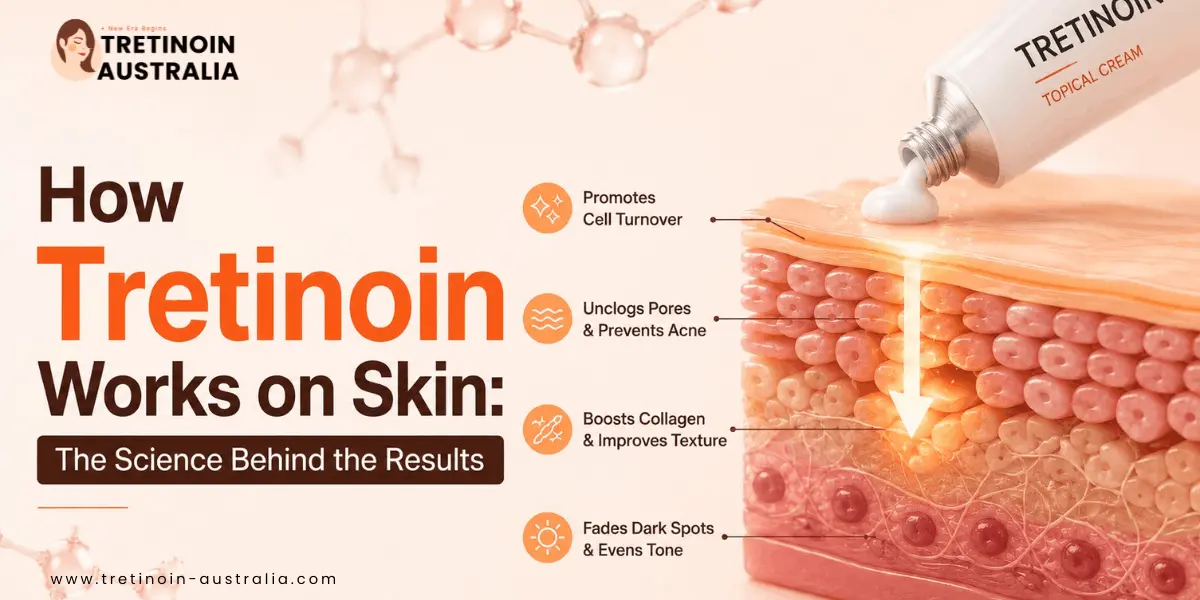
In short : Tretinoin cream [australia] is the acid form of vitamin A. It works by entering skin cells and binding to retinoic acid receptors in the cell nucleus, which switches on genes that speed up skin-cell turnover, normalise how pores shed cells, and stimulate collagen production. These changes are what drive its results for acne, fine lines and uneven pigmentation — though they take weeks to months to show.
Tretinoin cream [australia] is one of the most studied ingredients in dermatology, but most explanations stop at "it speeds up cell turnover." That's true, but it's only part of the picture. Understanding *how* tretinoin cream works at the cellular level explains why it treats such different concerns — acne, wrinkles and pigmentation — with a single molecule, and why patience matters so much with it.
This guide breaks down the science in plain English.
Tretinoin is all-trans retinoic acid - the biologically active, acid form of vitamin A (retinol). This is an important distinction. Skin can't use retinol directly; it first has to convert it, in two steps, into retinoic acid before it does anything. Tretinoin cream [australia] skips that conversion entirely because it's already the active form.
That's the core reason tretinoin is more potent than over-the-counter retinol, and also why it's a prescription-only (Schedule 4) medicine in Australia rather than a cosmetic. It acts directly on the cell's machinery.
For a side-by-side comparison, see [Tretinoin vs Retinol](/blog/tretinoin-vs-retinol/).
This is where the real action happens.
When tretinoin cream penetrates the skin and enters a cell, it travels to the nucleus and binds to a family of proteins called retinoic acid receptors (RARs) - specifically the subtypes RAR-α, RAR-β and RAR-γ. In skin, RAR-γ is the most abundant. These receptors pair up with a second set called retinoid X receptors (RXRs).
Once tretinoin cream [australia] docks onto these receptors, the bound receptor acts like a switch on your DNA. It turns certain genes on and others off, changing which proteins the cell produces. Everything tretinoin cream does to your skin flows from this single event: it is fundamentally a gene-regulating molecule, not a scrub or an exfoliating acid in the AHA/BHA sense.
This is also why tretinoin cream doesn't work instantly. Changing gene expression and rebuilding tissue is a slow biological process, not a surface reaction.
Once the receptors are activated, several distinct effects unfold in parallel.
Tretinoin cream [australia] accelerates the rate at which skin cells (keratinocytes) are produced in the lower epidermis and pushed up to the surface to be shed. Old, dull, unevenly pigmented cells are replaced more quickly with fresh ones. Over time this also thickens the living epidermis while compacting and smoothing the outermost layer — which is why texture and radiance improve.
In acne-prone skin, dead cells lining the hair follicle stick together and clog the pore, forming the microcomedone — the seed of every pimple. Tretinoin cream normalises how these follicular cells shed, keeping pores clear and preventing new blockages from forming. This is why it treats acne at its root and also helps prevent future breakouts, rather than just drying out existing spots.
More on this in [Tretinoin for Acne](/blog/tretinoin-for-acne/).
This is the effect that takes longest but matters most for ageing skin. Tretinoin cream:
So it works on both sides of the equation: building new collagen while slowing the destruction of existing collagen. The result, with long-term use, is a gradual softening of fine lines and improved firmness. This is structural change in the dermis, which is why it can take several months to become visible.
See [Tretinoin for Wrinkles and Ageing Skin](/blog/tretinoin-for-wrinkles/).
Tretinoin cream helps fade dark spots and uneven tone through two routes: the faster turnover disperses clustered melanin (pigment) and moves pigmented cells to the surface to be shed sooner, and it interferes with the transfer of pigment between cells. This is why it's often used as part of melasma and hyperpigmentation regimens - covered in [Tretinoin for Pigmentation and Melasma]
Because tretinoin cream [australia] works by changing gene expression and rebuilding tissue, the timeline is biological, not cosmetic:
|
Timeframe |
What's happening underneath |
|---|---|
|
Weeks 1–6 |
Cell turnover accelerates; skin adjusts. Often dryness, flaking, and a temporary as clogs surface. |
|
Weeks 6–12 |
Turnover normalises, breakouts begin to settle, texture starts to smooth. |
|
3–6 months |
Pigmentation evens out; early collagen benefits appear. |
|
6–12 months+ |
Fine-line and firmness improvements from collagen remodelling. |
The early irritation isn't a sign of damage — it's the visible side of the cell-turnover changes happening underneath. For a full breakdown, see [How Long Does Tretinoin Take to Work?](/blog/tretinoin-timeline/).
Two reasons, and both matter more in Australia's high-UV environment:
Daily broad-spectrum SPF isn't an optional add-on; it's what allows the mechanism to actually deliver.
Tretinoin cream [australia] isn't an exfoliant or a moisturiser - it's a vitamin A derivative that acts on your skin's genes. By binding to retinoic acid receptors, it speeds up and organises cell turnover, keeps pores clear, builds collagen and evens pigment. One mechanism, several benefits - but all of them unfold slowly, which is why consistency and sun protection matter more than strength.
Tretinoin enters skin cells and binds to retinoic acid receptors in the cell nucleus. This changes which genes are active, which speeds up skin-cell turnover, normalises how pores shed cells, and stimulates collagen production — driving its effects on acne, ageing and pigmentation.
Not in the way an AHA or BHA is. It doesn't dissolve the skin's surface chemically. Instead it changes cell behaviour from within, increasing the rate of natural cell turnover. The flaking many people see is a side effect of that, not surface exfoliation.
Because it works by altering gene expression and rebuilding tissue — including collagen in the deeper dermis — rather than acting on the surface. Turnover changes appear within weeks, but collagen remodelling can take 3–12 months to show.
Yes. Tretinoin stimulates fibroblasts to produce more type I and III collagen and also inhibits the UV-activated enzymes (MMPs) that break collagen down. This dual action is the basis of its anti-ageing effect.
Tretinoin cream increases sun sensitivity, and UV exposure activates the same collagen-degrading enzymes tretinoin cream works to suppress. Daily broad-spectrum SPF protects the skin and lets the treatment work - especially important in Australia's high-UV climat
Please log in to add a comment.

Dr. Emily Clarke is a skincare and dermatology writer based in Sydney, Australia. With over 12 years of clinical experience, she specialises in acne care, hormonal breakouts, and skin barrier repair. Emily is passionate about breaking down complex skin science into easy, relatable advice.She collaborates with Australian pharmacies and wellness platforms to promote evidence-based skincare.Her goal is to empower readers with knowledge to take control of their skin health. Outside of writing, she enjoys beach walks and testing new sunscreen formulas.
Subscribe for member-only pricing, restock alerts, and evidence-based skincare guidance from Tretinoin Australia.