
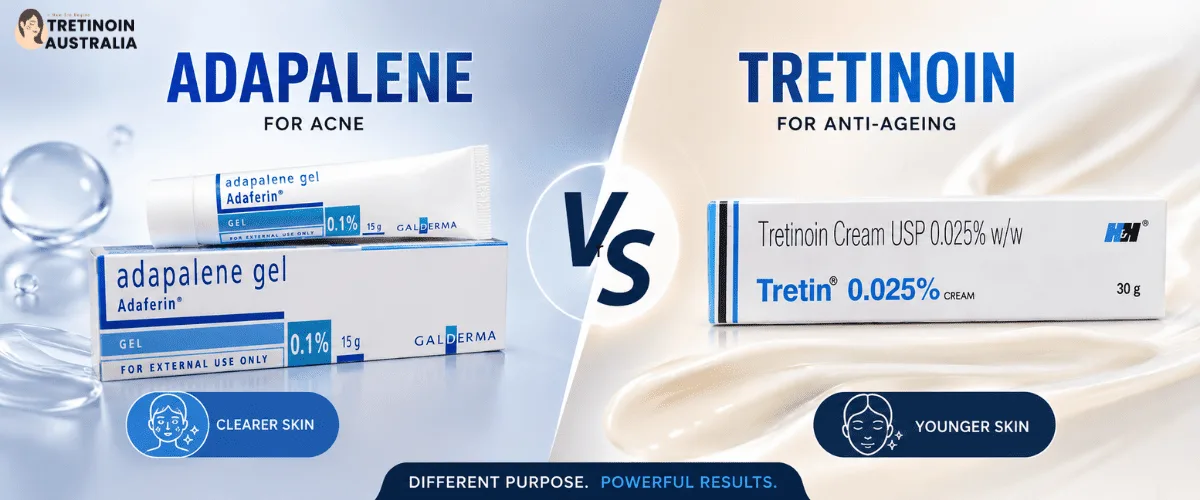
If you've spent any time researching retinoids, you've probably hit the same wall: adapalene or tretinoin? Both are vitamin A derivatives. Both speed up cell turnover. But they're not the same thing, and choosing the wrong one can mean months of frustrating results or skin that rebels hard during an Australian summer. This guide breaks down how adapalene and tretinoin compare for acne, anti-ageing, and sensitive skin. You'll walk away knowing exactly which one suits your skin right now, and where to get it in Australia.
Quick Answer: Is Tretinoin Stronger Than Adapalene?
Yes. Tretinoin binds to a broader range of retinoic acid receptors, making it more potent for both acne and anti-ageing. Adapalene is more selective in how it works, which makes it gentler but slightly less effective for wrinkles and fine lines. For most Australians starting out, adapalene is the easier entry point. For those ready to commit to real anti-ageing results, tretinoin delivers more.
Key Takeaways
Adapalene is a third-generation synthetic retinoid approved for acne treatment. It works by binding selectively to specific retinoic acid receptors (RAR-beta and RAR-gamma) in the skin, which helps normalise cell turnover and reduce the inflammation that leads to breakouts. Because it's more targeted in how it interacts with skin receptors, adapalene causes less irritation than older retinoids.
In Australia, adapalene 0.1% gel is sold under the brand name Differin and is available over the counter at most major pharmacies. A tube typically costs between AUD $30 and AUD $45. It's one of the few retinoids you can pick up without visiting a doctor, which is why it's often the first retinoid people try.
Our finding: Many first-time retinoid users in Australia start with adapalene specifically because the TGA allows OTC access. Most report manageable initial dryness, with skin adjusting within four to six weeks.
Adapalene 0.3% gel is a higher-strength option that's been shown in studies to rival tretinoin 0.025% for acne. But it's not as widely available in Australia. And it still doesn't hold a candle to tretinoin when it comes to anti-ageing.
Tretinoin is the gold standard retinoid. It's all-trans retinoic acid, which is the biologically active form of vitamin A your skin actually uses. Unlike adapalene, tretinoin binds to a wider range of retinoic acid receptors, which means it affects cell turnover, collagen production, and pigmentation more broadly.
It's been used in dermatology since the 1970s. Decades of research back its effectiveness for acne, fine lines, hyperpigmentation, and skin texture. No other topical ingredient has the same depth of clinical evidence behind it.
In Australia, tretinoin is a Schedule 4 prescription-only medicine regulated by the Therapeutic Goods Administration (TGA). You can't buy it off the shelf. A GP, dermatologist, or telehealth doctor must assess you and issue a prescription. Prices vary widely depending on whether you source it through a compounding pharmacy, an online telehealth service, or a traditional dermatologist referral, but expect to pay AUD $60 to AUD $180 or more for a tube.
Tretinoin comes in several strengths: [tretinoin 0.025% cream] is the standard starting point, while [tretinoin 0.05% cream] is the most commonly prescribed strength for both acne and anti-ageing in Australian clinical practice.
|
Feature |
Adapalene |
Tretinoin |
|---|---|---|
|
Strength |
Moderate (0.1%, 0.3%) |
Moderate to strong (0.025%, 0.05%, 0.1%) |
|
Prescription needed |
No (OTC in Australia) |
Yes (Schedule 4 via TGA) |
|
Best for |
Acne, comedones, maintenance |
Acne, anti-ageing, pigmentation, texture |
|
Side effects |
Mild dryness, occasional peeling |
Retinization (redness, peeling, sensitivity) |
|
Price in Australia |
AUD $30-$45 (OTC) |
AUD $60-$180+ (prescription required) |
|
OTC availability |
Yes (Differin 0.1%) |
No |
The table tells most of the story. Adapalene is accessible and forgiving. Tretinoin is more powerful but requires a prescription and a skin adjustment period. Which matters most depends entirely on what you want your skin to do.
For treating acne, both retinoids work. But the evidence tilts toward tretinoin at higher concentrations. A 2021 meta-analysis found tretinoin 0.05% reduced total acne lesions by around 60-70% after 12 weeks , while adapalene 0.1% achieved comparable results for mild to moderate acne. For severe or persistent acne, tretinoin tends to outperform.
Here's the nuance though: adapalene has genuine advantages for acne in some situations. It's photostable, meaning it doesn't degrade in sunlight the way tretinoin can. And because Australian summers push UV indexes above 12 in cities like Brisbane and Sydney, that stability matters if you're applying your retinoid close to dawn or if product packaging isn't airtight.
"Adapalene's anti-inflammatory mechanism also gives it an edge for acne with a strong inflammatory component. If you're dealing with red, painful papules rather than clogged pores, adapalene may calm the skin faster in the early weeks of treatment."
"Tretinoin is a better long-term acne solution for most people because it also addresses pigmentation and post-inflammatory hyperpigmentation left behind by old breakouts. Over time, skin cleared with tretinoin tends to look more even-toned. That's harder to achieve with adapalene alone."
For anti-ageing, tretinoin is the clear winner. It's the only topical retinoid with decades of robust clinical evidence showing it stimulates new collagen, reduces fine lines, and reverses some signs of photodamage . A landmark study found significant improvement in periorbital wrinkles, cheek roughness, and skin tone after 24 weeks of tretinoin 0.05% use .
Adapalene's anti-ageing evidence is thinner. Some small studies show it improves skin texture over time , but the data doesn't come close to tretinoin's track record. If anti-ageing is your primary goal, adapalene is a compromise.
Think of it this way. A 38-year-old in Melbourne who's been using Differin for two years to keep breakouts in check might start noticing that her skin texture isn't improving the way she'd hoped. Switching to tretinoin 0.025% or 0.05% at that point often delivers the texture refinement and fine line reduction that adapalene never quite got there on.
Tretinoin also addresses photoageing more directly. The UV exposure that comes with life in Australia accelerates skin ageing, and tretinoin is one of the few topicals with direct evidence of reversing UV-induced skin damage . That's a meaningful advantage for anyone who's spent years outdoors in Queensland or anywhere with high-intensity sun.
If your skin is sensitive or you've never used a retinoid before, adapalene is the lower-risk starting point. Tretinoin is effective but it demands a real adjustment period, and for sensitive skin types that period can feel rough.
Adapalene at 0.1% typically causes minimal purging. Most people experience some dryness in weeks two to four, but it rarely becomes severe. A 2020 head-to-head tolerability study found adapalene caused significantly less erythema (redness) and scaling than tretinoin 0.025% over a four-week initiation period . For someone in a Brisbane summer who's already dealing with heat-related flushing, that difference matters.
That said, "sensitive skin" is a spectrum. Some people who describe their skin as sensitive do perfectly well starting on tretinoin 0.025% if they buffer it correctly. Buffering means applying moisturiser first, waiting 20 minutes, then applying tretinoin. This slows absorption and cuts irritation significantly without reducing efficacy over the long term.
So if you're a complete retinoid beginner and your main concern is acne maintenance, start with adapalene. If you're motivated, willing to buffer, and your skin concerns extend beyond acne, going straight to [tretinoin 0.025% cream] is worth considering with medical guidance.
Both retinoids cause an adjustment period, but they're not the same experience. With adapalene, you'll likely see some flaking and mild dryness in the first two to three weeks. Purging (temporary breakouts as clogged pores surface faster) can happen but is usually brief and limited.
Tretinoin has a more pronounced adjustment phase, often called "retinization." This involves redness, peeling, tightness, and sometimes a significant purge in the first four to eight weeks. It can feel alarming if you're not prepared for it. But this phase passes, and skin typically emerges on the other side with noticeably improved texture.
A few side effects apply to both retinoids equally:
Increased sun sensitivity : Both adapalene and tretinoin thin the uppermost skin layer, making UV damage more likely. Always wear SPF 30 or higher daily. This is non-negotiable in Australia.
Dryness and peeling : Reduce frequency to every second or third night if irritation becomes severe. Don't stop entirely unless your skin is genuinely inflamed or breaking down.
Avoid mixing with certain actives : Benzoyl peroxide can degrade tretinoin on the skin. AHAs and BHAs can stack irritation. Start with a simple routine while your skin adjusts.
Short answer: no, not simultaneously. Using both in the same routine adds no benefit and significantly raises irritation risk. Both retinoids work on the same cellular pathways, so stacking them doesn't give you double the results. It just doubles the harshness on your skin barrier.
Some people use adapalene as a stepping stone before transitioning to tretinoin. That approach makes sense. Getting your skin comfortable with retinoids via adapalene first can make the switch to tretinoin smoother. But they're not a combination product.
If you've been using adapalene for six months or longer and want to upgrade to tretinoin, speak to a doctor. Transitioning without a break is usually fine, but your doctor can advise on whether to stop adapalene completely before starting tretinoin or taper the switch over a few weeks.
The right retinoid depends on your skin goals, skin tolerance, and how quickly you want results.
Choose adapalene if :
Choose tretinoin if:
For most Australians aged 30 and over with combined acne and skin ageing concerns, tretinoin is the better long-term investment. It does more. It has stronger evidence. And the prescription process in Australia is more accessible than it used to be.
For those under 30 dealing primarily with acne, or anyone who's tried nothing yet, adapalene is a completely reasonable and effective starting place.
Tretinoin is a Schedule 4 prescription medicine under TGA regulations, so you can't buy it off the shelf at a pharmacy. You need a valid Australian prescription.
Your options for getting a prescription include:
GP or dermatologist: The traditional route. A bulk-billed GP appointment costs nothing with a Medicare card, and many GPs in Sydney, Melbourne, and Brisbane are comfortable prescribing tretinoin for both acne and anti-ageing. Wait times for dermatologists can be long.
Telehealth services: Online telehealth platforms allow you to consult a doctor via video or questionnaire and receive a prescription digitally if appropriate. This has made tretinoin access much faster and more convenient for Australians outside major cities or those with busy schedules. [buy tretinoin online Australia](#)
Compounding pharmacies: Some Australians source tretinoin through compounding pharmacies, which formulate custom-strength products. This can allow for personalised concentrations not available in commercial products.
Once you have a prescription, you can fill it at any pharmacy dispensing Schedule 4 medicines, or through the telehealth provider's online dispensary.
Pricing in Australia ranges from about AUD $60 for a basic compounded formula to AUD $150 or more for branded commercial products. [tretinoin 0.025% cream] is typically more affordable and a smart starting strength. If you need higher concentration later, your doctor can adjust.
Conclusion :
Both adapalene and tretinoin are effective retinoids, but they serve different skin needs. Adapalene is accessible, well-tolerated, and excellent for acne. Tretinoin is stronger, better-researched for anti-ageing, and the more powerful option if you're serious about long-term skin improvement.
In Australia, the adapalene vs tretinoin decision often comes down to two things: what you want and whether you're ready to get a prescription. If you're ready to take the next step and want a retinoid that works harder for your skin over time, tretinoin is worth it.
Ready to start? Shop [tretinoin 0.025% cream] and [tretinoin 0.05% cream] at [tretinoin-australia.com] with a valid Australian prescription. If you need help getting one, online telehealth options can connect you with a doctor and buy tretinoin online Australia in a matter of days.
No. Tretinoin is a Schedule 4 prescription-only medicine in Australia under TGA regulations. You need a valid prescription from a registered Australian doctor, either through a GP, dermatologist, or telehealth service. Adapalene 0.1% (Differin) is the main retinoid available OTC at Australian pharmacies.
Tretinoin is stronger. It binds to a broader range of skin receptors and has more potent effects on cell turnover, collagen production, and pigmentation than adapalene. Adapalene is more targeted and gentler, which makes it better tolerated but less effective for anti-ageing purposes.
With adapalene, most people notice clearer skin within 8 to 12 weeks. Tretinoin typically takes a similar time for acne, but anti-ageing results like reduced fine lines and improved texture usually require 12 to 24 weeks of consistent use . Both require patience and daily SPF.
No. Using both simultaneously doesn't improve results and significantly increases irritation risk. They work on the same pathways, so combining them creates unnecessary stress on your skin barrier. Use one or the other, and consult a doctor before switching between them.
Adapalene's primary clinical approval is for acne. Some evidence suggests it modestly improves skin texture over time, but it doesn't have the same depth of anti-ageing research as tretinoin. If anti-ageing is your main goal, tretinoin 0.025% or 0.05% is the more evidence-backed choice for Australians.
Please log in to add a comment.

Dr. Emily Clarke is a skincare and dermatology writer based in Sydney, Australia. With over 12 years of clinical experience, she specialises in acne care, hormonal breakouts, and skin barrier repair. Emily is passionate about breaking down complex skin science into easy, relatable advice.She collaborates with Australian pharmacies and wellness platforms to promote evidence-based skincare.Her goal is to empower readers with knowledge to take control of their skin health. Outside of writing, she enjoys beach walks and testing new sunscreen formulas.
Subscribe for member-only pricing, restock alerts, and evidence-based skincare guidance from Tretinoin Australia.